


After years marked by overstimulation, constant notifications, and excessive screen time, 2026 is beginning to position itself as the year of the return to analog. There is growing demand for simple, in-person experiences that are less dependent on technology — especially during leisure time.
Summer, in particular, highlights a clear contrast: we are outside, in natural environments, yet still attached to our phones. Bringing back in-person games and simple physical activities is a direct way to counter this pattern and make better use of available time.
This is not about rejecting technology, but about creating moments when it is not necessary.
Below are suggestions for in-person games — some more popular, others less obvious — explained clearly so that any group can put them into practice.
1. Treasure Hunt

One person (or team) prepares written clues in advance that lead to different locations. Each clue leads to the next until reaching the final “treasure,” which can be a small symbolic prize.
What it develops: reasoning, cooperation, constant movement, and group engagement.
2. Mafia
Each participant receives a secret role (for example: one “assassin” and the remaining players). During normal group interaction, the “assassin” discreetly eliminates others using a pre-agreed gesture.
The rest try to figure out who is responsible through observation and voting.
What it develops: attention, behavioral reading, social interaction, and strategic thinking.
3. Sardines
A reverse version of hide-and-seek. One person hides and the others search. When someone finds the hidden person, they quietly join them. In the end, everyone is hidden in the same place and only one person remains searching.
Works best in medium or large groups.
What it develops: movement, suspense, and spontaneous fun.
4. Capture the Flag

The group splits into two teams. Each team has a territory and an object representing their “flag.” The goal is to enter the opposing territory, capture the flag, and return without being caught.
What it develops: running, strategy, cooperation, and natural energy expenditure.
5. Categories Game
A category is chosen (for example: cities, fruits, movies, brands). One person says a letter and, in quick turns, each participant must say a word from that category starting with that letter.
Whoever hesitates or repeats loses the round.
What it develops: mental agility, concentration, and memory.
6. Twister
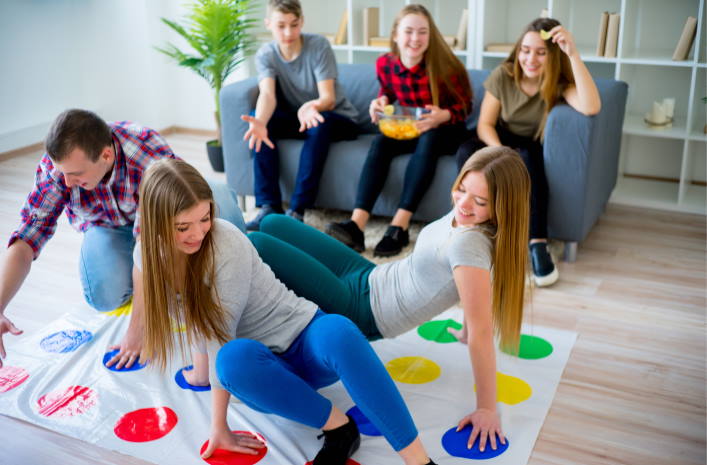
The game consists of a mat with colored circles on the floor. A player spins a pointer that indicates which color and which body part must be placed on that circle.
As the instructions progress, positions become increasingly challenging.
What it develops: mobility, balance, and coordination.
7. Truth or Dare
Each participant chooses between answering an honest question or completing a small challenge. It can be adapted to maintain a light and fun atmosphere.
Works well in small groups or at the end of the day.
What it develops: spontaneity, connection between people, and confidence.
8. Elastic Jump Game
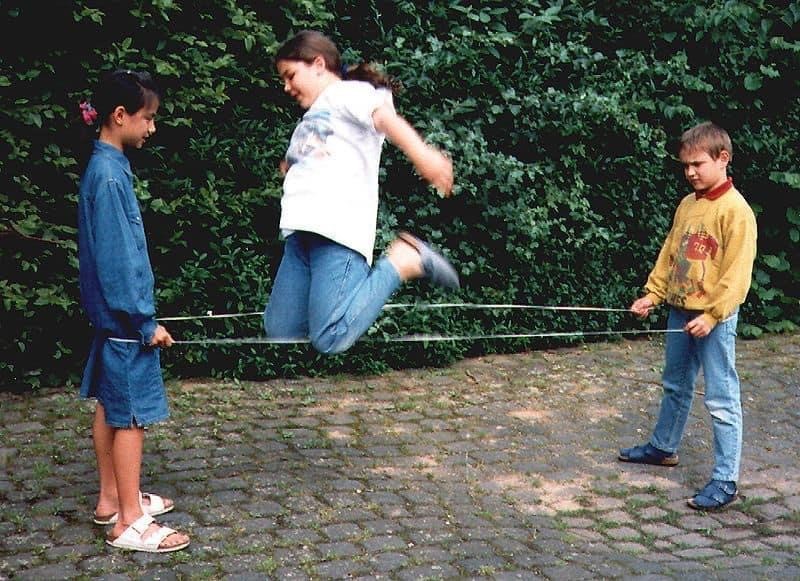
Two players hold an elastic band around their legs, forming a rectangle. A third player performs a predefined sequence of jumps. As difficulty increases, the elastic is raised higher.
It can be done in any flat space.
What it develops: coordination, endurance, and rhythm.
More than just entertainment, these games change group dynamics. When no one is holding a phone, attention becomes more evenly distributed and time seems to pass differently.
Physical health benefits
Even seemingly light games offer advantages:
- More natural movement: running, jumping, or reacting activates the body without feeling like formal exercise.
- Better coordination: games involving balls, rackets, or cards stimulate reflexes and motor coordination.
- Outdoor exposure: being outside helps regulate circadian rhythm and supports vitamin D production.
Mental health benefits
- Reduced constant stimulation: the brain stops switching between notifications and messages.
- Greater presence: interaction is no longer mediated by a screen.
- Reduced social comparison: less exposure to constant comparison triggers.
- Improved mood: playful activities promote well-being without digital overload.
Impact on relationships
- encourage conversation
- create shared memories
- strengthen family and friendship bonds
Phones individualize leisure time; shared games make it collective.
Deeper sleep and rest
Reducing screen time, especially at the end of the day, improves:
- sleep quality
- ease of falling asleep
- the feeling of being rested upon waking
How to apply it in practice
There’s no need to be radical. Small adjustments work best:
- set phone-free periods
- don’t bring the phone to the table
- choose one afternoon per week for outdoor games
- keep cards or simple games easily accessible
The key is to replace, not just remove.
If 2026 marks the return to analog, summer is the ideal time to begin. Simple, in-person games create more complete experiences than any app.
Less screen. More interaction. More movement. More presence.

